
Where the sun meets the soil: Cambodia’s journey toward a just and inclusive energy transition in agriculture

In Pursat Province, Cambodia, farmer and system technician Seng Thida helps operate the solar panels that now irrigate more than 300 hectares of rice fields. Photo by Vin Aranas/I-JET
Cambodia stands at an energy crossroads: diesel pumps still rumble in the fields, but new rows of solar panels are quietly changing what is possible for rural communities. Across its provinces, from floating villages to rice paddies, the question is no longer whether the country will embrace clean energy but whether the transition will be fair, inclusive, and lasting.
Since 2010, Cambodia’s electricity demand has increased by about 20% annually, reflecting the country’s rapid economic development and growing energy needs. By 2024, it had reached an installed generation capacity of 5,044 megawatts—an 8.5% increase from the previous year—and extended electricity to 99% of villages nationwide.
But behind these impressive figures lies a quieter truth: not everyone has been able to keep up. In rural areas, for instance, where about 76% of people rely directly on farming and fishing, access to reliable energy is still a daily challenge for smallholder producers. Many farmers depend on diesel-powered pumps to irrigate their fields, which are expensive,
polluting, and unreliable during fuel shortages. Others rely on manual labor or animal power, limiting productivity and resilience to droughts. Although electricity now reaches most villages, it often remains too costly or unstable for some farmers, keeping them trapped in low-yield cycles. Without affordable, clean power, it is difficult to run irrigation systems, process crops, or store produce—and even harder to imagine a modern, climate-resilient farming sector.
As Cambodia works to meet its growing power needs and climate goals, another truth becomes clear: the energy transition must also be a justice transition. Moving from fossil fuels to renewables is not enough; communities must have a say in how this change unfolds, who benefits, and who gets left behind.
This is the promise of a just energy transition (JET), one that puts people, equity, and sustainability at the center of development. A JET means ensuring that the shift to renewable energy creates decent jobs, strengthens cooperatives, empowers women, and builds community ownership over the resources that sustain life. It means seeing clean energy not just as infrastructure but as an engine of inclusion.
Cambodia’s story is also part of a larger movement across Southeast Asia, where countries are working to balance growth with sustainability under the ASEAN Plan of Action for Energy Cooperation (APAEC) 2026–2030. This plan, endorsed by energy ministers in 2025, recognizes that without equity and participation, even the cleanest technologies can reproduce the same old inequalities.
For policymakers, development workers, and donor agencies, Cambodia offers a vital lesson: lasting impact happens when people are part of the solution. When farmers manage their own solar irrigation systems, when women lead energy cooperatives, when marginalized communities gain the skills to shape energy policy—that is when transformation takes root.
The following stories from Kampong Chhnang, Pursat, and Battambang show what that transformation looks like in action. They reveal how communities once constrained by unreliable power are now cultivating not just their crops but their futures, proving that a just and inclusive energy transition begins where the sun meets the soil.
Kampong Chhang: Expanding seasons of growth through solar irrigation
The road to Toeuk Hout Meanchey Kdey SangKhem Agricultural Cooperative cuts through a patchwork of dry fields in Kampong Chhnang—a province long known as Cambodia’s Port of Pottery. Here, life follows the rhythm of the seasons: the rain brings green abundance, and the dry months turn the land brittle and bare.
Home to more than half a million people, Kampong Chhnang sits along the Tonlé Sap River, where most families depend on rice and vegetable farming for their livelihoods. But in recent years, longer dry spells and rising fuel costs have made it harder for farmers to thrive. In Toeuk Hout Meanchey, diesel-powered pumps once kept crops alive—but at a heavy cost. The machines demanded constant fuel and repairs, and even when they worked, they could do little against months of drought.
“Before, when the dry season came, we stopped farming,” said Mr. Chan Sath, 33, a farmer- member of the agricultural cooperative. “Between January and May, there was usually no harvest.”
In 2023, Solar Green Energy Co., Ltd. (SOGE), a renewable energy company in Cambodia, partnered with Toeuk Hout Meanchey, with funding support from USAID and the government, to install a community-operated solar irrigation system.
The system, which is currently in its piloting stage, uses solar-powered pumps connected to a water storage unit and a smartphone-based control app—the first of its kind in the province. Through the system, farmers like Chan can monitor water levels, switch pumps on or off, and track performance directly from their phones.
Ownership and management are shared among cooperative members and SOGE. Farmers oversee day-to-day operations and collect irrigation fees, while SOGE provides technical maintenance and training. Profits are distributed with 20% reinvested into community projects and 80% going to SOGE for system upkeep and future expansion. Reinvestments into community projects will increase incrementally to 40% in the fifth year.
Once fully operational, an initial 40 farmers are expected to irrigate four hectares of farmland year-round, cultivating onions, melons, and leafy greens even during the dry months. The system delivers about 600 cubic meters of water at a cost of just USD 0.15 per cubic meter, compared to diesel’s higher operating expense.
Beyond cost savings, farmers now enjoy more flexibility and control. Because the system is app-based, they can monitor and schedule irrigation remotely—often three to four times a day—instead of spending long hours guarding their fields.
“Before the system was in place, we spent hours in the fields to watch the pumps,” recalled Mr. Sun Sithol, 47, another farmer-member of the cooperative. “Now we can check the system on our phones, even from home. We have more time to rest, or to help with other work.”

Sun Sithol shows his onion farm watered by the solar irrigation system operated by the Toeuk Hout Meanchey Agricultural Cooperative. Photo by Vin Aranas/I-JET
With reliable water supply, the cooperative now plants two cropping cycles a year, doubling productivity and improving household income stability. The time saved and the predictability of water access have also improved farmers’ quality of life, giving them room to plan and diversify their work.
The cooperative’s model ensures long-term sustainability through collective ownership and transparent management. Members contribute small user fees that fund maintenance, and trained local technicians ensure that repairs and operations stay in community hands.
SOGE’s continuous mentoring has also built digital and technical literacy among farmers, making them confident operators of the system—a significant shift for a group once reliant on manual tools and unpredictable rainfall.
Toeuk Hout Meanchey’s experience shows that renewable energy is not only about powering farms; it is about empowering farmers. It is proof that when clean technology meets community ownership, the result is not just greener fields but a fairer future.
Pursat: Making water work for all
Like in Kampong Chhnang, farmers in Pursat once relied on diesel pumps to irrigate their crops—machines that were as noisy and polluting as they were expensive. Pursat, whose Khmer name means ‘floating banyan’, lies between the Cardamom Mountains and the Tonlé
Sap Lake and is one of Cambodia’s most productive rice-growing provinces, home to around 420,000 people. Its vast plains shimmer with rice during the rainy season, but as the rains grew unpredictable and fuel prices climbed, even these rich lands began to feel fragile.
For smallholder farmers, irrigation was both a necessity and a burden. Diesel costs could reach USD 100 per hectare per cropping season, forcing many to skip a planting cycle or borrow money just to keep their pumps running.
“Before, we couldn’t afford to irrigate much,” said Ms. Seng Thida, 41, a community leader at the local water user group. “We depended on the Pursat River, but during the dry season its water level was too low to reach all our fields. The water gates built by the government also often broke down or weren’t properly regulated, so some areas got water while others stayed dry.”
Farmers, hence, struggled with coordination. Without a shared water system, they operated individually, competing for river water and shouldering maintenance costs alone.
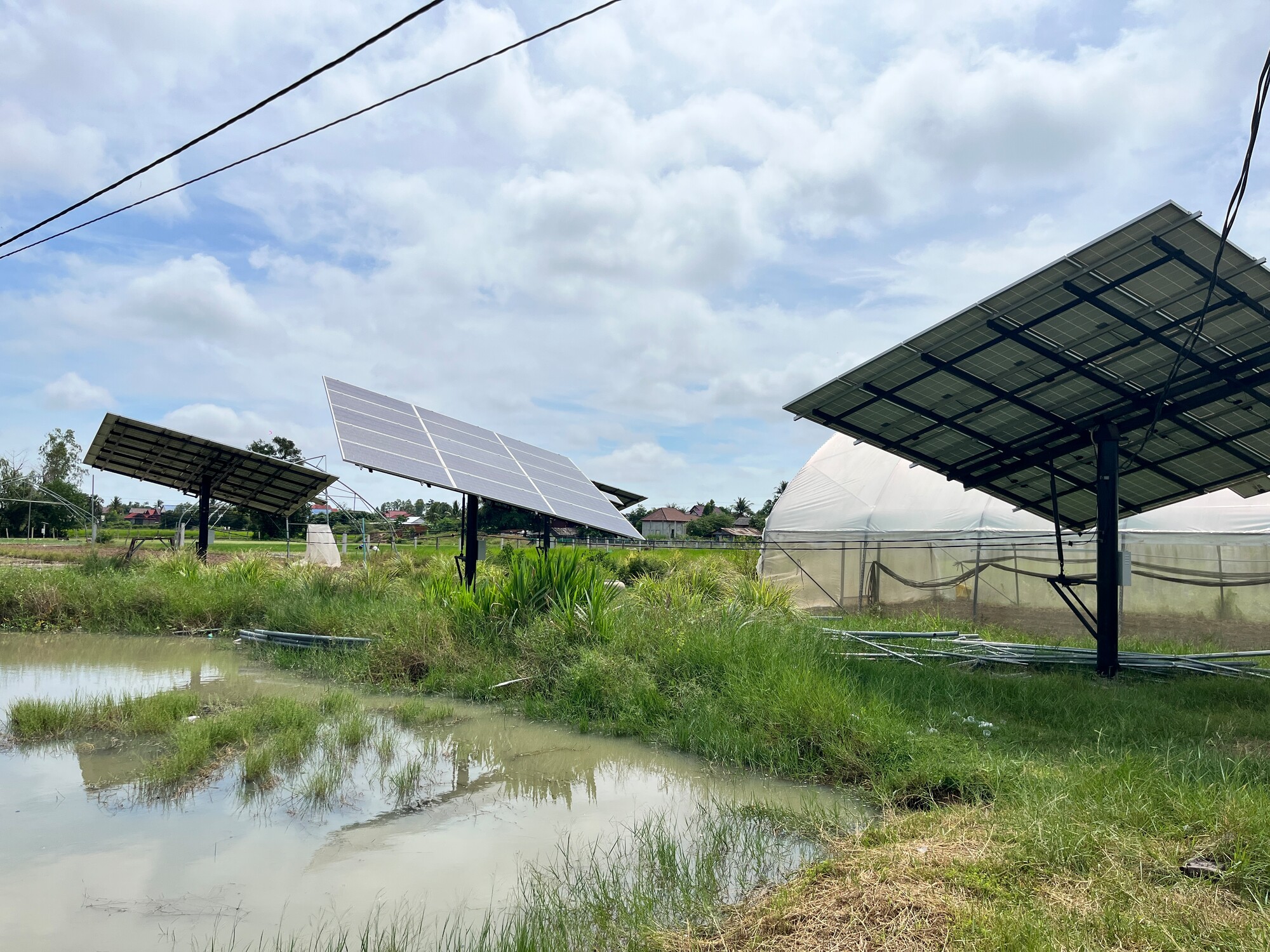
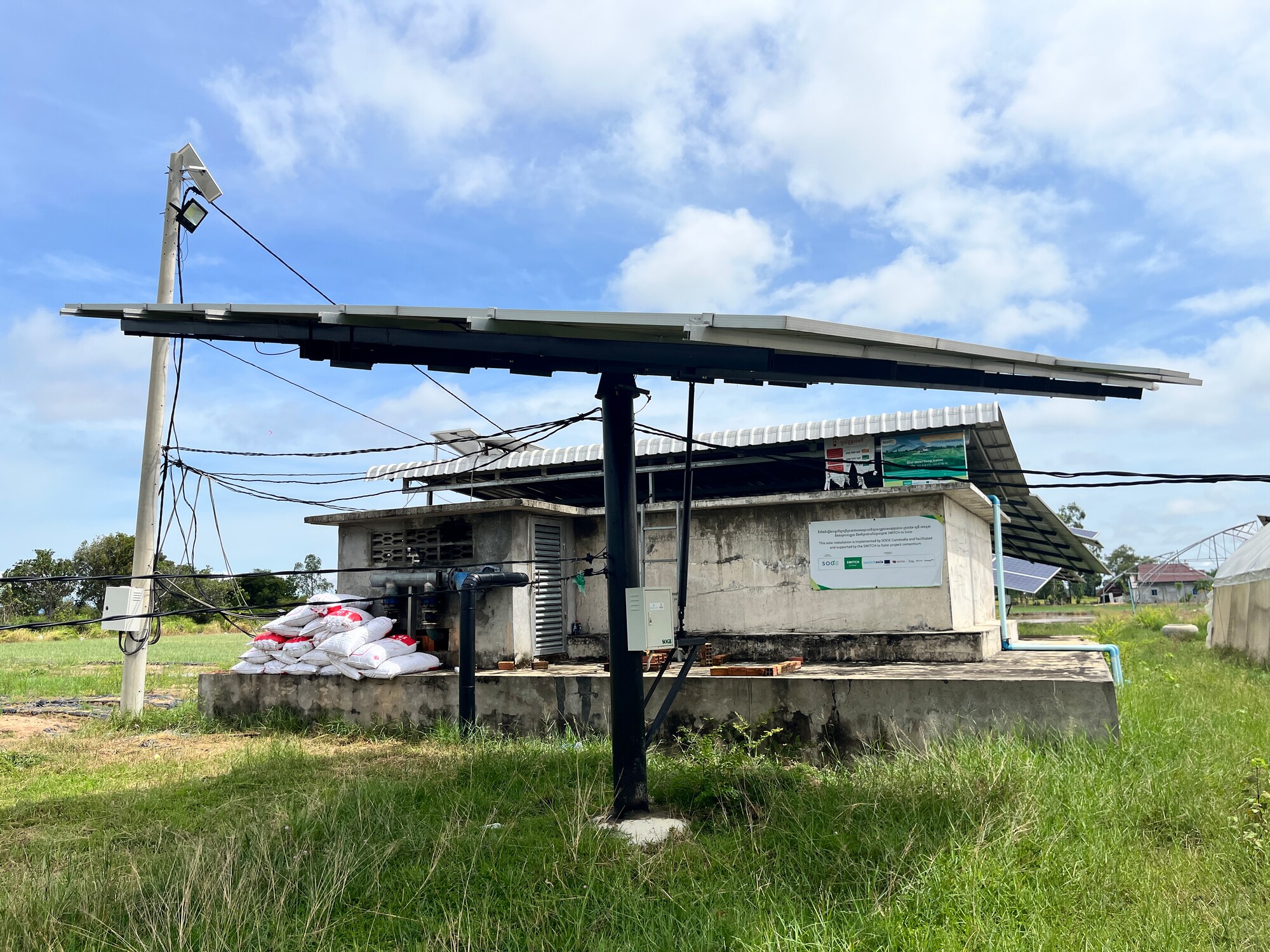
To support the rice-farming community, SOGE introduced a 50-kilowatt solar-powered irrigation system in 2022. The system now serves around 176 farmers across 300 hectares of rice fields, replacing diesel pumps with clean, low-cost solar power.
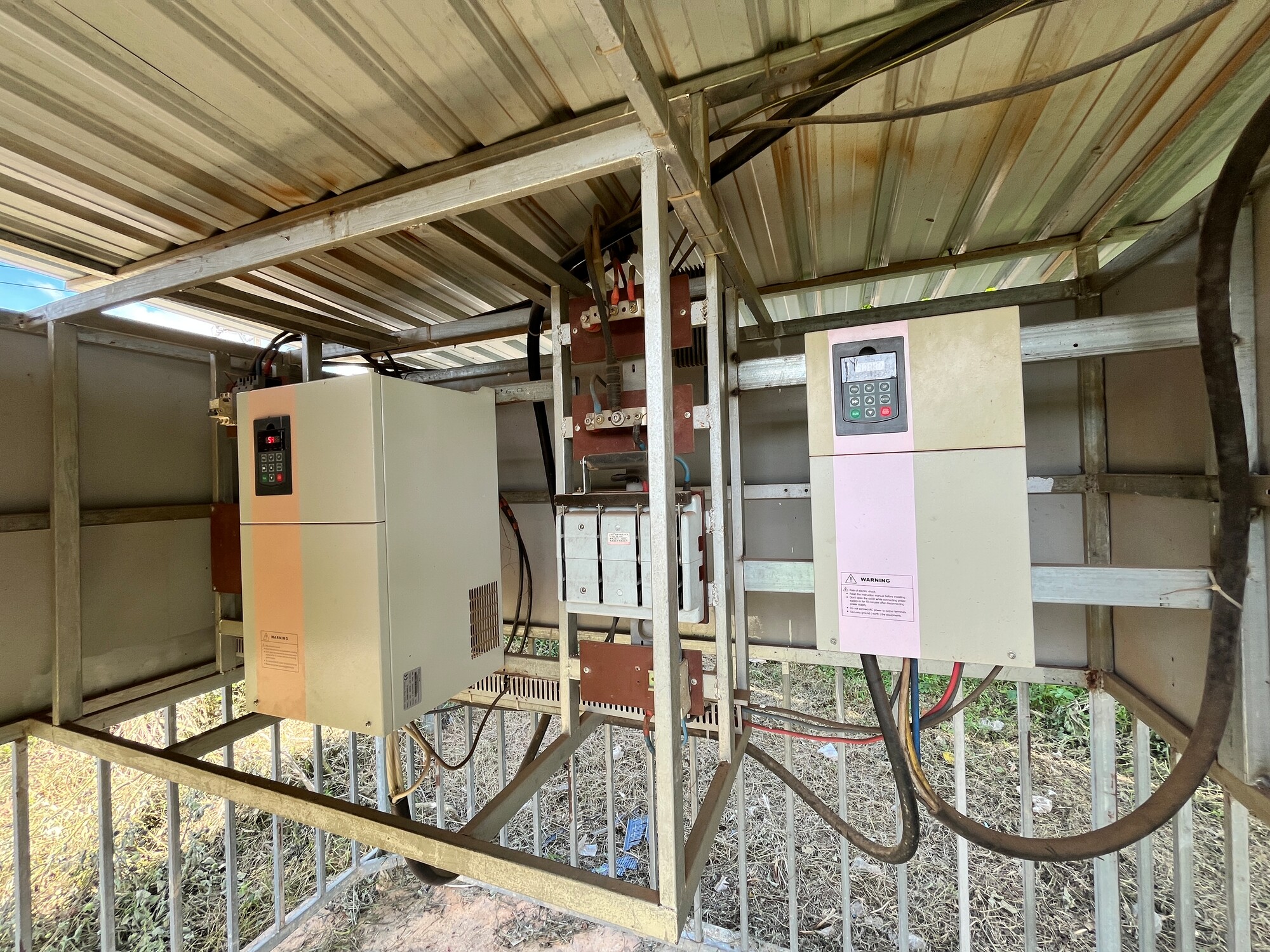
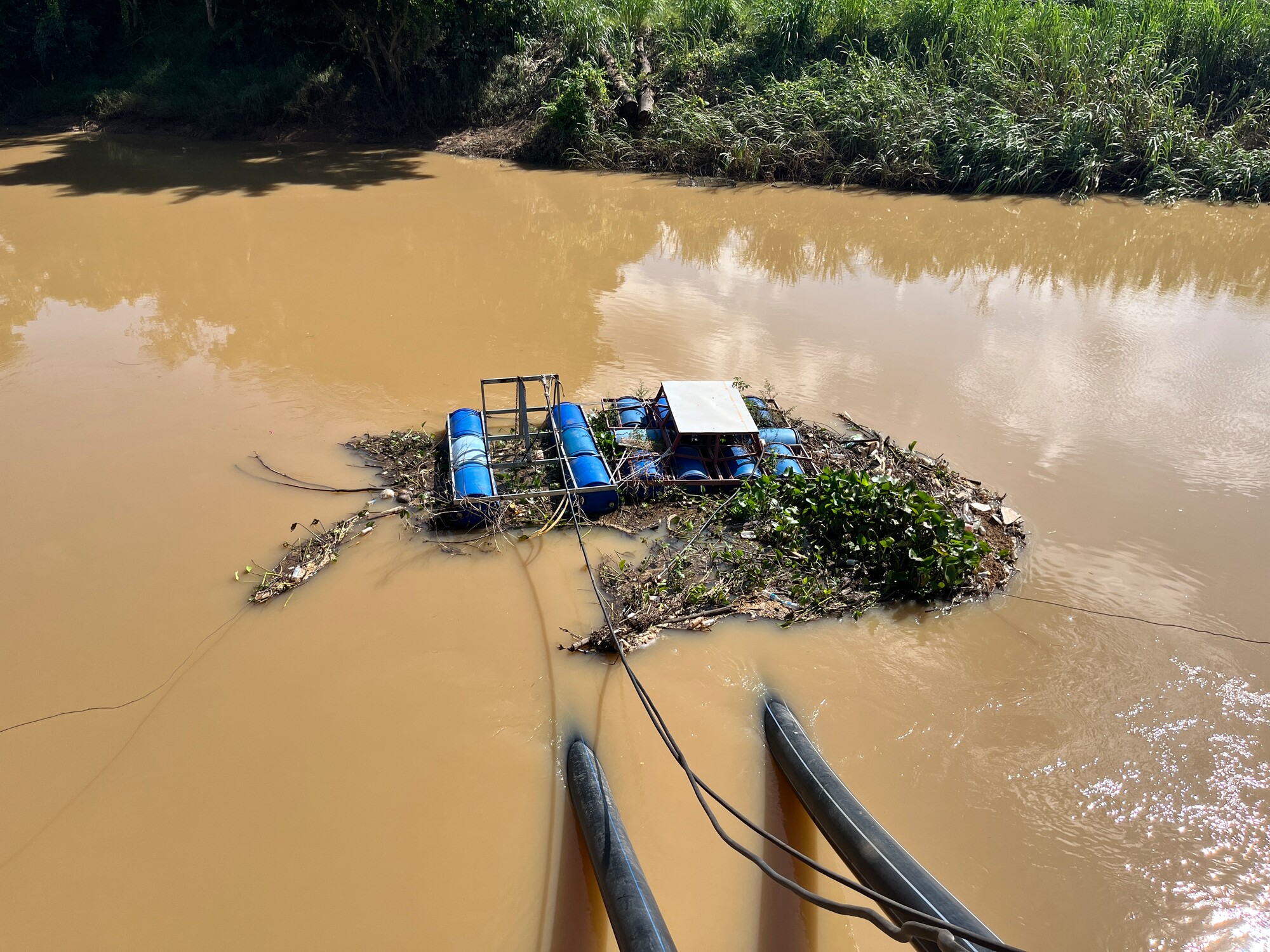
To ensure community co-ownership, the system’s management was handed over to a water user group, officially registered under the Provincial Department of Water Resources and Meteorology. SOGE also hired Seng as the local technician responsible for the day-to-day operation and monitoring of the solar pumps. The group collects modest user fees—about USD 63 per hectare per cropping cycle—which are used primarily to pay for technical services and maintenance. A small portion of the fees is reinvested into the community fund, which the group uses to repair the dike system and support other shared infrastructure needs.
“This project helped us organize ourselves,” said Seng. “Before, everyone just pumped their own water. Now, we plan the irrigation together and make sure everyone gets enough.”
The shift to solar power has transformed how farmers in Pursat work and plan their crops. By replacing diesel, the community has reduced irrigation costs by nearly 40% per hectare, freeing up income for other farming needs. With reliable, continuous water supply, they can now plant two cropping cycles a year instead of just one. According to estimates from SOGE, farmers now harvest 3 to 5 tons of rice per hectare per season—a significant increase, particularly during the dry months when production used to drop sharply.
“The water comes more regularly now,” said Seng, smiling as she watched her rice fields shimmer under the sun. “We used to stay in the fields all day to manage the pumps. Now the committee runs the system; we just follow the schedule.”

Members of the water user group speak about the economic and social benefits of the solar irrigation system. Photo by Vin Aranas/I-JET
The difference is not only economic but also social and environmental. For instance, Seng’s role as the project’s technical assistant is a rare occurrence for women in Cambodia’s agricultural sector. Her leadership has inspired other women in the community to take part in training and cooperative decision making. Meanwhile, without the smoke and noise of diesel pumps, the air feels cleaner, and the fields are quieter. The user group’s irrigation schedule has also reduced disputes over water use, encouraging farmers to plan and share more effectively.
The Pursat model combines renewable energy with community governance. The water user group ensures transparent fee collection and equitable distribution of water, while technical support from SOGE keeps the system efficient. Because it is owned by SOGE and operated by the community, the project does not depend on outside support, making it financially and socially sustainable.
At the same time, the switch from fossil fuel to solar aligns with Cambodia’s Nationally Determined Contribution targets under the Paris Agreement, helping reduce emissions from agriculture, one of the country’s largest sources of carbon output.
The water user group’s experience demonstrates that clean energy is not just a technological shift but a social one. Farmers now spend less, produce more, and cooperate better. With stable irrigation, families can now plan their harvests—and their futures—with more confidence.
Battambang: Powering a cooperative future
In Cambodia’s northwest, Battambang stretches across vast plains of rice, fruit, and sugarcane—fields that feed much of the nation. Known as the country’s Rice Bowl, it is home to over 980,000 people, many of whom depend on farming for their livelihoods. Yet despite its abundance, the province has faced familiar challenges: unpredictable weather, rising fuel costs, and an energy system still dominated by diesel.
In Wattamim commune, where nearly 92% of residents farm rice and fruit, irrigation once depended entirely on diesel-powered pumps. These machines were expensive, prone to breakdowns, and left farmers vulnerable to fuel shortages. When global oil prices rose in 2022, for instance, the cost of keeping crops alive soared beyond reach.

Leader of the Wattamim Water User Cooperative and Commune Chief, Im Svang, led a commune meeting to discuss the current situation in the cooperative-owned solar irrigation system. Photo by Vin Aranas/I-JET
“When diesel got expensive, we had to cut down on irrigation,” said Mr. Im Svang, 75, the commune chief and chairman of the Wattamim Water Usage Cooperative. “Some of our land was left unused because we could not afford to pump water every day.”
Like farmers in Kampong Chhnang and Pursat, those in Battambang faced a critical question: how to secure water for their fields without draining their income or harming the environment.
In June 2024, the Wattamim Water Usage Cooperative partnered with SOGE and Oxfam to install a solar-powered irrigation system covering 188 hectares of rice fields and 75 hectares of fruit crops. The system is designed to expand to 400 hectares in the coming years, benefiting nearly 200 farming households.
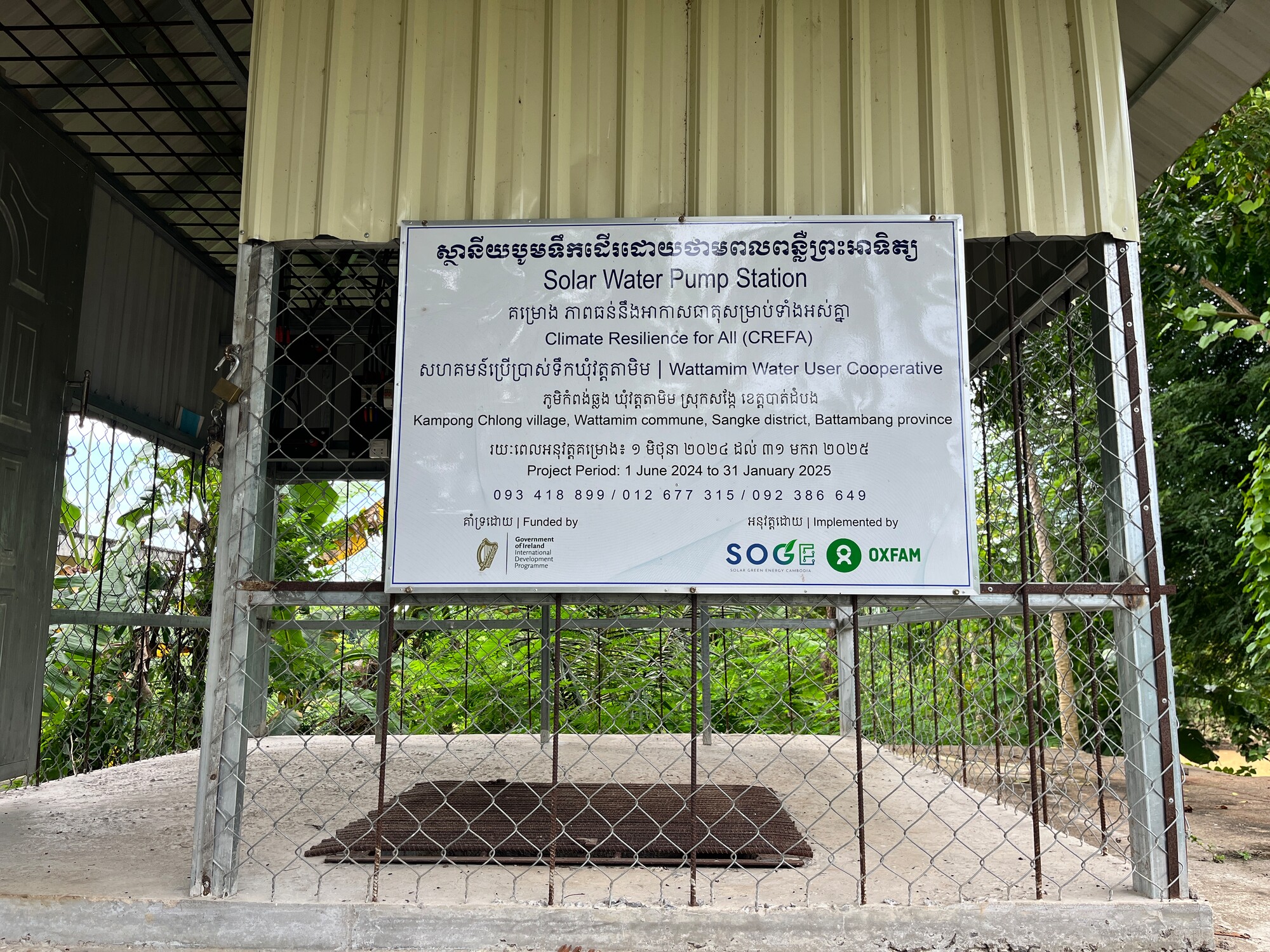
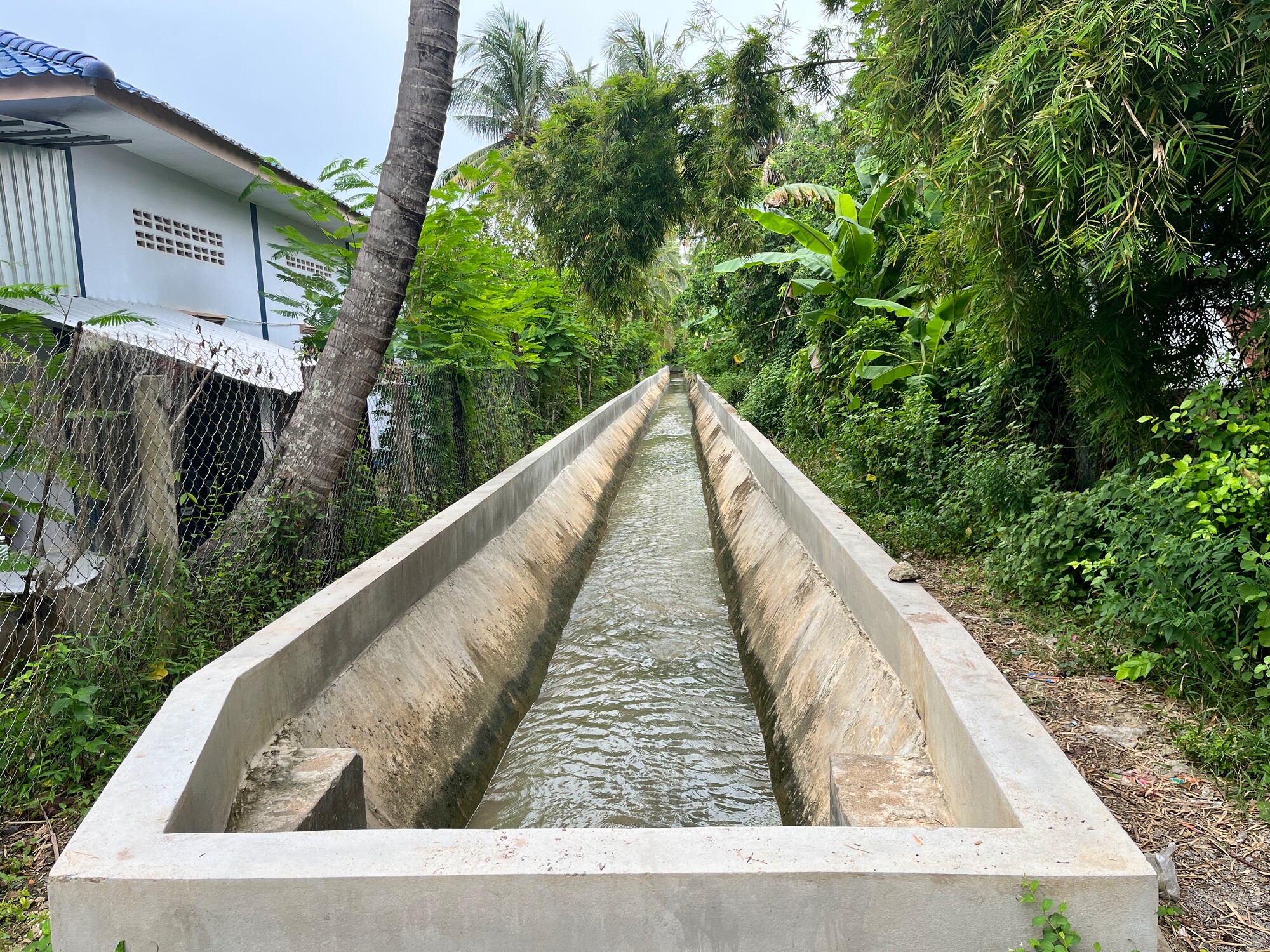
The cooperative’s management system is simple but effective. Each member contributes a user fee to cover operation and maintenance costs—USD 75 per hectare per cycle for shareholders and USD 82 for nonmembers for rice fields, and USD 100 per hectare for fruit farms. Dividends are returned to shareholders at the end of each cropping season.
The solar irrigation system has brought immediate improvements. Farmers now have a reliable water supply throughout the year, even during the driest months. The system runs silently and without smoke, a welcome change from the noisy, fuel-hungry engines of the past.
“Before, the diesel pump could only run for two hours a day,” said commune chief Im. “Now, the water flows all day. Even during droughts, our crops survive.”
The system also freed farmers from the daily labor of managing pumps and buying fuel. With solar, water distribution follows a schedule coordinated by the cooperative, giving farmers more time for other work or family responsibilities.
The cooperative has also built resilience against climate risks. During floods, trained technicians learned to safely shut down and protect the solar infrastructure, a sign of growing technical confidence among local operators.
These improvements encouraged more farmers to join the cooperative. “When others saw how well the solar irrigation system worked, they decided to become members too,” said Im.

A few kilometers from the water pump station, solar panels line a reservoir that the commune hopes to use as a water source during droughts. Commune members say additional infrastructure investments are needed to make this possible. Photo by Vin Aranas/I-JET
The cooperative model keeps the project strong. Members collectively manage water schedules, fees, and maintenance, while SOGE provides ongoing technical assistance. Transparent record-keeping and reinvestment of savings have made the system self- sustaining.
Women’s participation has also grown: 40–50% of cooperative members are women, many taking on roles in administration and decision making, an important step toward inclusive local governance.
Moreover, the commune is exploring how to use surplus solar energy during the rainy season for processing, drying, and water storage, extending the system’s value beyond irrigation.
For Battambang’s farmers, solar irrigation is more than a technological upgrade; it is a symbol of renewal. Reliable water has revived 188 hectares of previously unproductive land, improved yields, and reduced household spending on fuel. Farmers now earn more and work smarter, not harder.
The Wattamim experience shows how JET principles can thrive at the community level: collective ownership, gender inclusion, and local innovation working hand in hand. What began as a pilot is now a model, one that other communes in Battambang are eager to follow.
Pathways to a just energy future: Lessons from Cambodia’s farming communities
Across Kampong Chhnang, Pursat, and Battambang, solar irrigation is showing what practical, community-led energy transition looks like on the ground. Farmers who once depended on costly diesel pumps now manage clean, reliable systems powered by the sun. These initiatives are reducing emissions, lowering production costs, and strengthening livelihoods—all while building the technical and organizational capacity of rural cooperatives.
What began as pilot projects are now working examples of how just and inclusive energy transition principles can take root in Cambodia’s agricultural sector. By combining local ownership, equitable access, and renewable technology, these models demonstrate that clean energy can deliver both environmental and social benefits.
As Cambodia and its Southeast Asian neighbors expand their renewable energy ambitions, the experiences of these provinces highlight a clear message: when communities are trusted as partners—not just beneficiaries—energy transition becomes more inclusive, sustainable, and just.
1 United Nations Development Programme. (2023). Energy efficiency: A key pillar of Cambodia’s energy future. UNDP Cambodia. https://www.undp.org/cambodia/publications/energy-efficiency-key-pillar-cambodias-energy-future.
2 Cambodian People’s Party. (2025, February 4). Cambodia’s installed electricity capacity reaches 5,044 MW in 2024. https://www.cpp.org.kh/en/details/400239? (accessed on 30 October 2025).
3 The World Bank. (2024). Cambodia Inclusive Livestock Value Chains Project (P180535) — Project Appraisal Document. The World Bank. https://documents1.worldbank.org/curated/en/099121724002033205/pdf/P18053516de7b00d189e8127bdc6ce9ef5.pdf.
4 ASEAN Centre for Energy. (2025). ASEAN Plan of Action for Energy Cooperation (APAEC) 2026-2030. ASEAN Centre for Energy. https://aseanenergy.org/publications/asean-plan-of-action-for-energy-cooperation-apaec-2026-2030/.
5 National Institute of Statistics. (2024). Cambodia inter-censal population survey: Kampong Chhnang province. Ministry of Planning, Kingdom of Cambodia. https://data.opendevelopmentcambodia.net/km/dataset/555b11f8-9f9a-47cc-8104-
7324ff624fb3/resource/a30ed4aa-8e47-4ed8-8803-6a7002fbe106/download/cambodia-inter-censal-population-survey- 2024.pdf.
6 Solar Green Energy (Cambodia) Co., Ltd. (2024). About us. https://www.sogecambodia.com/en/about-us/ (accessed on 30 October 2025).
7 National Institute of Statistics. (2024). Distribution of total population by province in Cambodia, 2024 [Dataset]. Ministry of Economy and Finance. https://data.mef.gov.kh/datasets/pd_6837d994dbc953000126f651.
8 National Institute of Statistics. (2019). Provisional population census 2019: Cambodia. Ministry of Planning, Kingdom of Cambodia. https://www.nis.gov.kh/nis/Census2019/Provisional%20Population%20Census%202019_English_FINAL.pdf.
9 Data provided by the Commune Chief.