
From Rivers to Regional Halls: How Oxfam IP3 Brought Local Voices to ASEAN Climate Action

The climate crisis is not abstract; it is lived daily along rivers, in flood-prone homes, and within communities whose resilience is constantly tested. At the recent ASEAN Civil Society and Partners Exchange Conference on Gender and Climate Change in Vientiane, Lao PDR, diverse perspectives converged to demand a more inclusive, gender-responsive, and socially just climate agenda. Among the most powerful contributions was how Oxfam’s IP3 program helped bridge local realities with regional decision-making, ensuring that the often-unheard voices were heard at the ASEAN level. Among 206 participants, 138 of whom were women and two preferred not being identified, were representatives from 89 CSOs, 56 INGOs, and 56 government agencies. The participants from ASEAN were 9 ASEAN CSOs from across the region; this included 11 participants/3 male representatives. This event forged a vital consensus among ASEAN stakeholders, powerfully underscoring the voices of local civil society. These voices articulated a strong commitment to promoting gender equality and Gender Equality, Disability, and Social Inclusion (GEDSI), explicitly linking these principles to climate action.
This gathering served as a platform to unite diverse actors in developing collective action to respond to climate impacts and build resilience for the broader ASEAN community and the Mekong Sub-region. By fostering new connections and enhancing collaboration, this regional workshop extends its influence beyond the Mekong. It amplifies a collective voice and forges wider partnerships, solidifying a broader regional commitment to a coordinated and responsive climate strategy across ASEAN.
Local Realities: Cambodia and Vietnam Speak Out
In Cambodia’s Ratanakiri province, communities who are living along the rivers shared how declining ecosystems, floods, and water scarcity are reshaping local livelihoods. Indigenous families, women, and vulnerable groups emphasized the need for dignity, clean water, and community-led adaptation. Their stories highlighted that resilience is not just a technical matter; it is a cultural, social factor that are deeply tied to identity.

“This conference was important because it featured many presentations, sharing of experiences on the way relevant activities are implemented and the impacts of climate change across different country contexts. However, we face similar challenges related to GEDSI and climate change. It was a powerful reminder that climate change is a shared challenge and so is the need for gender equality and social inclusion. Practical lessons are also shared through, like Brunei’s integration of climate topics into school curricula and creative zero-waste initiatives led by young women, turning recycled materials into useful products, the visiting of women with disability centre where the place give hope and light to women with disability.  These stories prove that inclusive solutions are not just possible, they are already happening.”
In Vietnam, the Hanoi Association of People with Disability showcased how GPS mapping of households with People with Disability transformed disaster preparedness intervention. By integrating disability data into national monitoring systems, they demonstrated that inclusive technology could save lives and ensure no one is left behind during floods and typhoons.
“People with Disability often have highly practical insights into infrastructure gaps, resilience strategies, and overlooked risks especially in rural or flood-prone areas. Therefore, they are not only to be consulted but should become part of the implementation team and engage in all phases. Consultation is good. Co-creation is better. Power-sharing is the best! ‘Nothing about us without us’: It means nothing for resilience unless it includes those who depend on resilience the most.”
Regional Demands: Civil Society’s Call to Action
The ASEAN Civil Society Call to Action crystallized these experiences into regional priorities:
- Mainstream GEDSI (Gender Equality, Disability, and Social Inclusion) into climate governance and financing.
- Ensure meaningful participation of women, youth, Indigenous Peoples, and Persons with Disability in ASEAN climate coordination mechanisms.
- Invest in the care economy as critical climate infrastructure.
- Strengthen data systems with sex, age, and disability disaggregation to inform inclusive policies.
- These demands reflect a growing consensus: resilience cannot be achieved without equity.
The Joint ASEAN Statement on Call for Action emphasizes the urgent need to advance Gender Equality, Disability, and Social Inclusion (GEDSI) across all climate change and disaster risk reduction efforts. It seeks to bring these commitments directly to the attention of ASEAN working groups including those on Gender, Environment, and Climate as well as to the respective governments of ASEAN Member States. By channeling this call into formal ASEAN coordination mechanisms and national policy processes, the statement aims to ensure that inclusive, accountable, and coordinated actions are embedded in regional governance, financing, and implementation, thereby strengthening resilience and equity across the region.
How Oxfam IP3’s Weaving Local into Regional
Oxfam’s Mekong Inclusion Project Phase-3 (IP3) has been critical in visualising local realities into regional climate resilience strategies. By amplifying diverse voices such as Indigenous women in Cambodia and disability organizations in Vietnam IP3 ensured that grassroots testimonies shaped ASEAN-level dialogue rather than being sidelined. It translated these lived experiences into actionable recommendations aligned with frameworks like ASEAN Agreement on Disaster Management and Emergency Response (AADMER) and the Gender Mainstreaming Strategic Framework, proving that resilience is stronger when communities lead and their leadership is recognised in policy spaces.
During the panel discussion, Ms. Kaneka Keo, the Climate Resilience Lead of Oxfam’s Mekong Inclusion Project phase 3 emphasized the critical role civil society organizations (CSOs) play in reinforcing policy commitments and monitoring government pledges made at platforms such as COP and the ASEAN Summit. While CSOs may not always have a seat at the negotiation table alongside the policymakers, their influence remains significant at the national level through strategic engagement. To drive meaningful change, CSOs must clearly understand the policy landscape identifying the right moments and mechanisms to exert influence effectively. This calls for building stronger capacity, collaboration, and evidence-based advocacy so CSOs can shape climate and GEDSI agendas where it matters most.
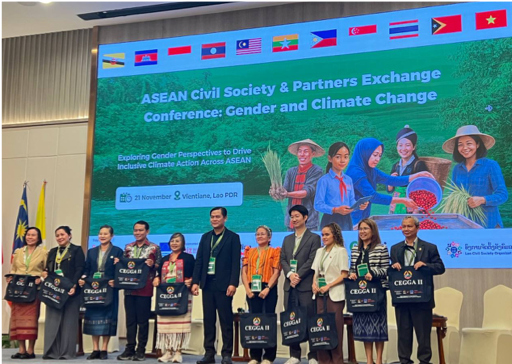
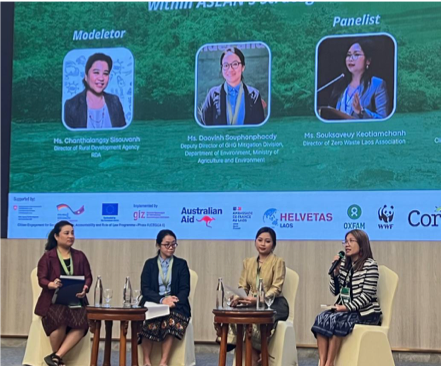
By bringing together river defenders, Indigenous leaders, women’s groups, and disability advocates, Oxfam showed that GEDSI transformation is not a sidenote or tokenistic agenda; it is the foundation of climate resilience. The ASEAN stage became a platform where local realities informed regional commitments, proving that inclusive governance is both possible and necessary.
The journey from the Sesan Rivers in Ratanakiri and Hanoi’s flood-prone homes to ASEAN’s regional halls is evidence of the power of solidarity. Oxfam IP3 work reminds us that climate resilience stands the strongest when the interventions are built on diverse perspectives, lived experiences, and the connecting voices of those most affected, particularly women, Indigenous women, and People with Disability.